SelfSelector

The metafleshical writings of Dennis Cooper: an approximation

Posted in Literature by Lorena Muñoz-Alonso on June 28, 2007

Some weeks ago, a journalist from El Mundo, a famous Spanish newspaper, defined the characters of Dennis Cooper’s novels as “depraved or bored little Americans that have a go to gay life between whiskey, money, drugs and multiple forms of hardcore sex”. Given the fact that this critic is a professional reviewer of Oscar Wilde, we are quite sorry to say that his point of view doesn’t match at all with the true essence of the work of this North American writer, born in Pasadena in 1953.
HellCooperJonesRichard Hell (left), Dennis Cooper (center) and friend in the 80′s.

His last novel published in Spain by El Tercer Nombre –called originally The Sluts (Void Books, 2004 / Carroll & Graf, 2005)– is nothing of what you would expect from its cover: a product for consumers of soft gay literature, David Leavitt-style. It doesn’t display good taste or bourgeois eroticism with a decadent tone. Cooper, let’s get this straight, writes from his obsessions, that are neither comfortable nor digestive. Not for us and not even for himself. The Sluts has been renamed for its Spanish edition Chaperos (Rent Boys), the only mistake of a otherwise fairly good translation by Juan Bonilla. This new title is quite wrong because the novel is not about a group of male prostitutes, but just one: a ghostly teenager. He is the center point, the sun of a constellation of avid clients that get in touch by means of faxes, SMS, e-mails and Internet forums to satisfy their dark needs. To all those new to Cooper’s work and circumstances we should note that he is one of the highest priests of the digital revolution applied to culture (from the web world to video-games) and that he has spread writings and poems through his two blogs –www.denniscooper.blogspot.com (already closed) and www.denniscoopertheweaklings.blogspot.com (in active) – where the author unveils himself as a rather nice and considerate host. To them and to his official website (www.denniscooper.net) we relocate people that wants to know a bit more about his new book and all these obsessions than we mentioned before, that range from curious and nice to dreadful.

Untitled-4Dream Police, poetry compilation and The Sluts, his last novel.

From this and other sources we know that Cooper lived an unhappy childhood as the son of a millionaire California couple, described on his first poems with a mix of sarcasm and shame. The young Dennis relieved the resentment produced by this environement training to become a sort of hippie and diving into pornography, music, drugs and books. Infatuated by French culture since an early age, his first steps into literature were taken in the shadow of Sade, Rimbaud and the Surrealists. Input he completed with trash culture in the shape of rock & roll and that so very North American cult to the psychokiller as the ultimate expression of social alarm. He then went to University but never completed any degree. In 1973 he published his first book of poems and three years later he founded a poetry magazine called Little Caesar (that you can download on www.denniscooper.net/littlecaesar/lcmagazine.htm), followed by a small publishing group that released his own work and fellow’s Tim Dlugos.

Untitled-3Portraits of a young Dennis Cooper.

At 23 he listened to the Sex Pistols’ Anarchy in the UK and began his first European pilgrimage (soon to be followed by many others, all marked by excess). Between addictions, psychosexual torments and creative lows he arrived to 1983, when he reunited with George Miles, a former high school friend with severe mental problems and “the most important person I have known all my life”, as he described him. This relationship pushed him to narrative prose at last. Cooper had been in love with Miles for years and the consummation of that love, followed by the desertion of his partner and the fear of Cooper “to hurt someone” guided by his ghosts, led him to organize a plan: he would win back his loved one if he made him the star (a weak, beautiful, fragile and drugged up star) of all his stories and tales. In his own words “every young character in every piece of fiction I have written is George, whether by name or not”. George Miles killed himself in 1987 but Cooper didn’t find out until ten years later.

The cycle of 5 novels published between 1989 and 2000 are the result of this obsession. The ones we mostly recommend are Frisk (1991), Try (1994) and Period (2000). All of them can de defined like black comedies or twisted versions of the 80’s teen comedies. But in Cooper’s universe the main characters are young or even younger and are facing adults that most of the time are rapist and psycopaths at their best. One of the adults of Frisk is called Dennis and shares many biographical facts with the own writer. That might be te key to understand many things about him. Cooper shows on these books his grasp on slang and witty dialogs as well as being able to make interesting and hooking books based on schematic and sometimes even weak plots. We should not ignore his sense of humor: he didn’t hesitate in using the music band Blur (without any previous consent) as the stars of his novel Guide (1997), focused especially on bassist player Alex James. The British band, after reading the book, declined the invitation to meet him. Frisk became a film in 1995, and even though the soundtrack was composed by Bob Mould, of his adored band Hüsker Dü, Cooper was not satisfied at all with the result and that was the begginning and the end of his collaboration with the world of cinema.

Untitled-2Closer, Try and Period, three of the five novels that form the Miles Cycle.

The novels of the Miles Cycle took Cooper out of the “highbrow” circuit into the center of the mass culture. The erotic and violent essence of his books turned him into the favorite target of the conservatory sectors but also of some gay groups that didn’t get his point, so to speak. The Queer Nation association accused him of encouraging homophobia and the writer David Leavitt makes outraged critics whenever he has the chance. On the other hand William S. Burroughs and Edmund White have always praised his frankness and talent.

Untitled-1Hüsker Dü, My Bloody Valentine, Sonic Youth… Friends and references.

The teenager aesthetic of his novels and his use of musical references (My Bloody Valentine, Hüsker Dü, Joy Division, Slayer…) turned the author into an unexpected common ground for youngsters of both genders, straight and homo, identified with the inner void and teenage angst expressed in his novels. The involuntary involvement of Dennis Cooper in the literature mega-fraud of JT Leroy sadly averted the attention of the public away of his two following novels My Loose Thread (Cannongate Books, 2002) and the unorthodox detective store God Jr. (Grove Press, 2005), both highly recommended.

In 2004 the friendship between Cooper and Sonic Youth, Guided by Voices and Xiu Xiu among many other bands lead to the tribute record Dennis, released also by Void Books. His latest bet has been to jump on the theatre scene: his plays I Apologize (2004), Un Belle Enfant Blonde (2005) and Kindertotenlieder (2007)– written in collaboration with Giselle Vienne– had been performed in Paris, London and several USA cities. All his friends and acquaintances have described him as a nice but shy person, always willing to help or contribute with ideas. Sheltered under a barrier of video-games, music and literary erudition he continues to explore his dark side. And ours.

denniscooperjeanlucbertini

Dennis Cooper these days. Portrait by Jean-Luc Bertini.

Thanks to Yago Garcia Salmeron for his contribution

“Bonnie” de Saint Phalle & “Clyde” Tinguely

Posted in Art by Lorena Muñoz-Alonso on June 13, 2007

If you have wandered around the Centre Pompidou in Paris, you have most likely stumbled upon the work of two very special artists: Niki de Saint Phalle and Jean Tinguely, also know as the Bonnie & Clyde of Art because they were a fascinating couple and they liked to use shotguns and explosives in their shocking pieces and installations.

libro052Niki de Saint Phalle and Jean Tinguely in 1961.

So to one side of the Pompidou there is big fountain with a group of sculptures. It’s called La Fontaine Stravinsky and it is one of their last joint works of art and also one of their most famous, probably due to its fantastic location. This fountain is the perfect symbol of their personalities and styles, so different and yet so complementary. On one hand we have Jean’s masculine, sharp, metallic and mobile sculptures. On the other, the colorful, feminine and voluptuous pieces of Niki. At first sight they don’t seem to match at all but, on closer look, you discover how they empower and highlight each other. That perfect contradiction also happens when you examine the couple.

libro057La Fontaine Stravinsly (1983), Paris.

Niki was a French-American girl (born in 1930 in the south of France but educated in the United States) that worked as model for Vogue and Harper’s Baazar, got married at 18 and became a mother at 21 before even considering the possibility of entering the world of Art. It was actually thanks to her first husband, Harry Matthews, a musician that liked to hang out with plastic artists, that she got in touch with the world of creation, moving together to Paris in 1952. But as much compromised with Art as she became the following years, she never neglected her aesthetical appeal, that she learned during her modelling years. She always had a very personal and styled look, often wearing custom-made Christian Dior dresses and cultivating a sophisticated look that in the 60′s and 70′s collided with the uprising feminist trend, that was prone to judge that taking care of the outside was sexist, conservatory and, worst of all, shallow. Niki never minded that and, as much as “hands-on” as she was, and as much dirty as she got while doing her Nanas (to the point of dying due to a respiratory illness produced by the toxic fumes of the polyester paints she used), she always ended looking more a like a flamboyant movie star than an careless artist.

jeanbuenoBlanc Jaune et Noir (1956) and Trois points blancs (1955), by Jean Tinguely.

Swiss born Jean Tinguely (1925-1991) was a well-known kinetic artist that had left Basel for Paris in 1953. Trained as a decorator, a work he did for several years, it was painting and sculpture that won him in the end. His style was quickly recognizable and appreciated: rough mobile pieces that looked like strange machines, a style that had it roots in Marcel Duchamp and that even got a proper name: metamechanics. He was then married to another painter, Eva Aeppli, and also had a daughter. The atelier they shared in Paris was a meetig point for all the artist of the city, from Brancusi to Yves Klein, but in 1955 they received a visit that changed his life: a North-american called Harry Matthews and her young wife, Niki de Saint-Phalle, a self-taught incipient painter, already fascinated by Antonio Gaudí (her main influence), whose work she had got to know through several trips to Spain.

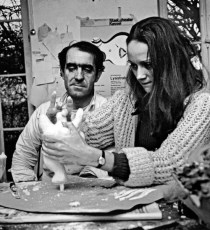
bJean and Niki modelling a Nana at their Paris house in 1966.

But it wasn’t until five years later, in 1960, when they had both divorced their first partners (in friendly terms) that they started their tumultuous and prolific relationship rooted in Paris. They both took part in the exhibition called The Movement at the Moderna Museet of Stockholm, and fell in love in the process. Jean proved to be final push that Niki needed to become an artist on her own terms. They both maintained separately successful careers, but their collaborations were constant and celebrated. The mix resulting from crossing their personalities had allure and strenght. Masculine vs. feminine. Sharp vs. round. Besides, they also helped and influenced each other in most of their individual pieces, so its difficult to draw a separating line in their bodies of work.

One example is the Study for an end of the world, an habitual concept in Tinguely’s work (he did two studies between 1961 and 1962), which consisted of a representation of chaos and destruction by the explosion of a series of sculptures with dynamite and fireworks. The audience of this art action witnessed a series of figures violently exploding and jumping in the air, that ended with a French flag descending from the sky to the ground with a parachute.

Niki got famous when she began her shooting paintings, a new type of piece, half painting and half performance, because they only happened when she shot (with a proper shotgun) plaster-covered collages she had previously designed with attached bags filled with painting that exploded in dripping colours. But it was her Nanas that became her trademark: big sculptures in the shape of curvy women painted in bright colours.

libro058Niki at one her shooting paintings, Malibu (1962).

They also were part of the gang of agitators of the 60′s New York, formed by John Cage, Merce Cunningham, David Tudor, Robert Rauschenberg, Jasper Johns and Frank Stella amongst others, and they took part on several happenings and performances that were seminal for both Contemporary Music and Art.

libro053Diagram of Hon, their inhabitable sculpture project in Stockholm (1966).

In 1966, again in the Moderna Museet of Stockholm and again curated by Pontus Hulten (a fundamental figure in their careers) they created of their most interesting and influential projects: Hon, a giant size Nana that hosted several spaces (from bars to a cinema) for people to walk through and whose access was in her sex, like a huge fertility goddess. It was revolutionary, controversial, new and funny (and if you take a look to Atelier Van Lieshout’s currents projects you will find more than a common point). It lasted three months, and was destroyed after.

libro054Public entering Hon (through her sex), Moderna Museet Stockholm (1966).

During the following years and decades, they never stopped creating, from little sculptures to huge installation, paintings, even films. In 1979, they started their bigger and most ambitious project, and Niki’s dream of a lifetime: the Tarot Garden. A tale-like park inhabited by her fantastic creations, no longer in sculpture size but reaching architectonic scale, all together creating an epic piece of land-art. Niki had been fascinated by Gaudí’s Güell Park since visiting Barcelona in the 50′s and from that moment on, she never stopped dreaming of building a space of her own. Jean always encouraged her to do it. It was a huge project that took many years to be finished. In fact, Jean Tinguely never saw it completed (he died in 1991), and it only stopped when also Niki died, in 2002. She wrote about it: “When I met Jean for the first time, I was a 25 year old girl with my pockets full of drawings. I dreamt of building a crazy castle, like a chapel for all religions. But when I told him, he didn’t laugh. He took it seriously. I said my dreams were bigger than my abilities, and he answered me with a sentence that changed my life: ‘Niki, the dream is everything. The technique is something you can learn’. With his brilliant help I realized my obsession of building something of monumental proportions“. So they found a lost location, in the middle of the Tuscan landscape, in Italy, and started constructing Niki’s masterpiece with Jean’s distinctive touch. A public space for people to experience and enjoy the fantastic, imaginative universe these two persons created for themselves and for all of us.

libro056Part of the Tarot Garden, Tuscany (Italy, 1979-2002).


More info at:
http://www.nikidesaintphalle.com/ http://www.tinguely.ch/fr/museum/jean_tinguely.html

Follow

Get every new post delivered to your Inbox.

Join 300 other followers