Rosa Barba. A Curated Conference
(This review was originally published on www.frieze.com in June 2010)
Manuel Borja-Villel’s latest strategy to reinvent the Museo Reina Sofía sounds just as crisis-friendly as it is promising: inviting a roster of noteworthy artists to curate a series of shows using the permanent collection –18,000 pieces and counting – in what looks like a remake of MoMA’s successful ‘Artist’s Choice’ programme, which began in 1989. Accepting the invitation of Reina Sofía’s chief curator, Lynne Cooke, the Italian-born, Berlin-based artist Rosa Barba has recently inaugurated the first instalment of this new scheme. The resulting exhibition, ‘A Curated Conference’, revolves around the metaphor of the exhibition as a conference, the gallery being the stage and the artists the ‘speakers’.
The idea of the speaker turns out to be quite relevant in this two-room display, as the works communicate in true conversational style. The first room has a big indexical diagram that Barba – who has chosen not to show any of her own work despite being part of the collection – designed as a declaration of intent. Alongside this diagram, subtle and restrained works by Lili Dujourie, Mira Schendel, Francis Alÿs and Joëlle Tuerlinckx fill the small opening room, which feels somehow silent and preparatory.
It’s in the second, main room, where the ‘chatter’ begins: the clatter of 16mm projectors interacts with the muffled soundtracks of video works shown on TV monitors and large screens. Here, the individual legibility of the works is not a priority. All the voices are meant to be experienced as a multiple, uneven clamour. Even the black-screen pauses, the silence between the pieces, have been technically programmed. Nothing is left at random: that David Lamelas’ everyday experiments in To Pour Milk into a Glass (1972) clatter exactly opposite Paul Sharits’ Word Movie (1966), or that Gordon Matta-Clark’s burlesque acrobatics in Clockshower (1973) take place to the relentless hammering soundtrack of Joan Jonas’ Vertical Roll (1972) is no coincidence. Two pairs of monitors are scattered in the room, each of them dramatizing their own male-female conversation. In one pair we find Yvonne Rainer versus Guy Debord. On the other set, Valie Export’s Syntagma (1983), a meditation on female representation, cinema and subjectivity is coupled with a selection of Nam June Paik’s videos of early performances.
Out of forty pieces that made the final selection, twenty belong to the moving image format, split between three big screens with DVD projections, four TV monitors and three 16mm projectors right in the middle of the room, each of them placed beside Carl Andre’s Magnesium Copper Plain (1969), a self-reflexive token of Barba’s own use of celluloid projectors as sculptural devices in her practice, highlighted here by its pairing with such an iconic minimalist work. Highly choreographed in phenomenological terms, ‘A Curated Conference’ oozes the nuances and plastic concerns typical of an artist. Barba’s first experience as a curator shows an obvious fondness for the seminal figures of film and video practice from the 1960s and ‘70s, as well as for the ideals of the Fluxus movement. What is not so evident in its first reading is that most of the pieces on display share a humorous or ironic look at both life and art.
Barba has confessed she seized this opportunity to explore works relevant to her practice, so it’s easy to understand why so many works here are in 16mm (some of them transferred to video). But there is more to it than personal delight, as one can sense a sincere engagement in bringing together the collection and its audience, resulting in this subjective and exhilarating lesson in 20th-century art history.
Photography is present through works by Cindy Sherman, Tacita Dean and David Wojnarowicz’s poignant Arthur Rimbaud in New York (Duchamp) (1978–9/2004). And, bearing in mind the institutional context, there is also a selection of Spanish artists, from Picasso and fellow cubist María Blanchard to Antoni Muntadas and the sculptor Cristina Iglesias. We can even witness a silent drama taking place between two works: Marcel Duchamp’s The Bride Stripped Bare by her Bachelors Even (The Green Box) (1934), a compilation of the preparatory sketches and notes for his Large Glass, is displayed in a cabinet underneath Louise Bourgeois’ Spider (1994) – the menacing arachnid becoming an ingenious embodiment of Duchamp’s dominant and dangerously erotic ‘bride’.
—
All images: Installation views by Lorena Muñoz-Alonso
6th Berlin Biennale for Contemporary Art: Renzo Martens / Mark Boulos
(This review was originally published on this is tomorrow in June 2010)
What Is Waiting Out There is the title of the 6th Berlin Biennale and, if we are to produce an answer based on the works in show, the future looks pretty bleak. That gloomy feeling, which resonates coherently with the current socio-economic landscape, is moreover problematised with the overarching concept: an examination of reality, in an epoch where claims to objectivity have long been abandoned in favour of a fear/fascination with staging and performativity. If mistrust is the defining malaise of contemporary Realism, the show put together by curator Kathrin Rhomberg clearly succeeds: most of the works in the biennale –where politically engaged documentary video and photography are key– raise the right questions for the wrong reasons. Doubt and paradox take over the experience, they accompany the viewer along the exhibition like an unwanted friend.
Access to Danh Vo’s exhibition at the 6th Berlin Biennale, 2010
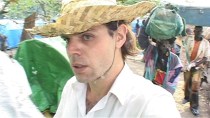
Out of the more than 40 artists gathered for this 6th edition, there is one player that perfectly exemplifies such controversies. Episode III (2008), by Dutch artist Renzo Martens, is an extremely layered and contradictory work that portrays him as a Fitzcarraldo figure of sorts gone to Congo to preach the assets of impoverishment to the locals, by redefining it a ‘natural resource’. Episode III adopts the form of a gonzo documentary that highlights the ways in which the First World economy profits from the impoverished African regions while launching ineffective aid programs to save face. Martens achieves this by making statements and creating situations that keenly question both the international handling of the issue and the agency of political art itself. However this leaves the viewer feeling that his cynicism has gone too far and reached obscene proportions. Is he not exploiting those poor communities he wants to help, just the same as all those westerners (photographers, aid organisations, politicians) he is pointing at, and then touring the biennale and gallery circuit like a morally superior hero himself?
Renzo Martens, Episode 3, Enjoy Poverty (2008) video still. Courtesy the artist; Galerie Fons Welters, Amsterdam; Wilkinson Gallery, London, copyright the artist
For all those who Renzo Martens’ ninety minute-long opus leaves an uncomfortable taste in the mouth, there is another work in the Biennale dealing with a related set of issues, which seems to tackle the complexities of African post-colonialism in a subtler way, in what almost feels like balm of intellectual rigour and common sense. Everything That Is Solid Melts into Air (2008) by Mark Boulos borrows its title from a sentence from the Communist Manifesto, and delves into the idea of commodity fetishism applied to the production of oil in Nigeria and its subsequent speculative use in North America. Consisting of a two-channel synchronised video installation, each screen depicts one of the two factions struggling for control of the precious good. On one screen we find the Nigerian guerrillas that seek to alleviate the misery of the region by redistributing the oil resources by all means necessary. The opposing screen shows the theatricality of the Chicago Mercantile Exchange, the largest exchange of futures and derivatives, where corporations trade goods that don’t even exist yet. That removal of the material stuff –absent from both the land where it comes from and trade where is exchanged– is what Boulos means by ‘melting into air’, the path to metaphysical qualities. The two facing screens, which portray such polarised but inextricable realities, build a dialectic and hypnotic space for thought.
Mark Boulos, All That Is Solid Melts into Air (2008), installation view. Courtesy the artist, copyright the artist
The dialogue and comparison between the works is a productive tool to comprehend a biennale where one could feel the least important thing is the art itself, prioritising political and epistemological endeavours in detriment of sensuous and sensorial enjoyment. But there are quite a few things to be gained by engaging with these apparently aloof works. By negotiating the gap between the socio-political events and how they are represented we are already looking at them differently.


leave a comment